

Bitcoin Portfolio Balance Sheet: A Simple Guide

Bitcoin. It’s the digital gold rush of our time. But unlike physical gold, knowing where your Bitcoin sits in your overall financial picture can be tricky for most businesses. That’s where a bitcoin portfolio balance sheet comes in. It’s your snapshot of how Bitcoin and other digital assets fit alongside your traditional investments.
This article will walk you through everything you need to know, from understanding the basics of a Bitcoin portfolio balance sheet to managing your Bitcoin investments effectively.
Disclaimer:
Cryptoworth refers to one or more of Cryptoworth Corporation, a private company, its network of member firms, and their related entities. Cryptoworth Corporation and each of its member firms maybe legally separate and independent entities. Cryptoworth Corporation is a registered business. No legal, tax, investment, or other advice is provided by any Cryptoworth Corporation. Please consult your legal/tax/investment professional for questions about your specific circumstances. Cryptocurrency holdings involve a high degree of risk, and can fluctuate greatly on any given hour
Key Takeaways
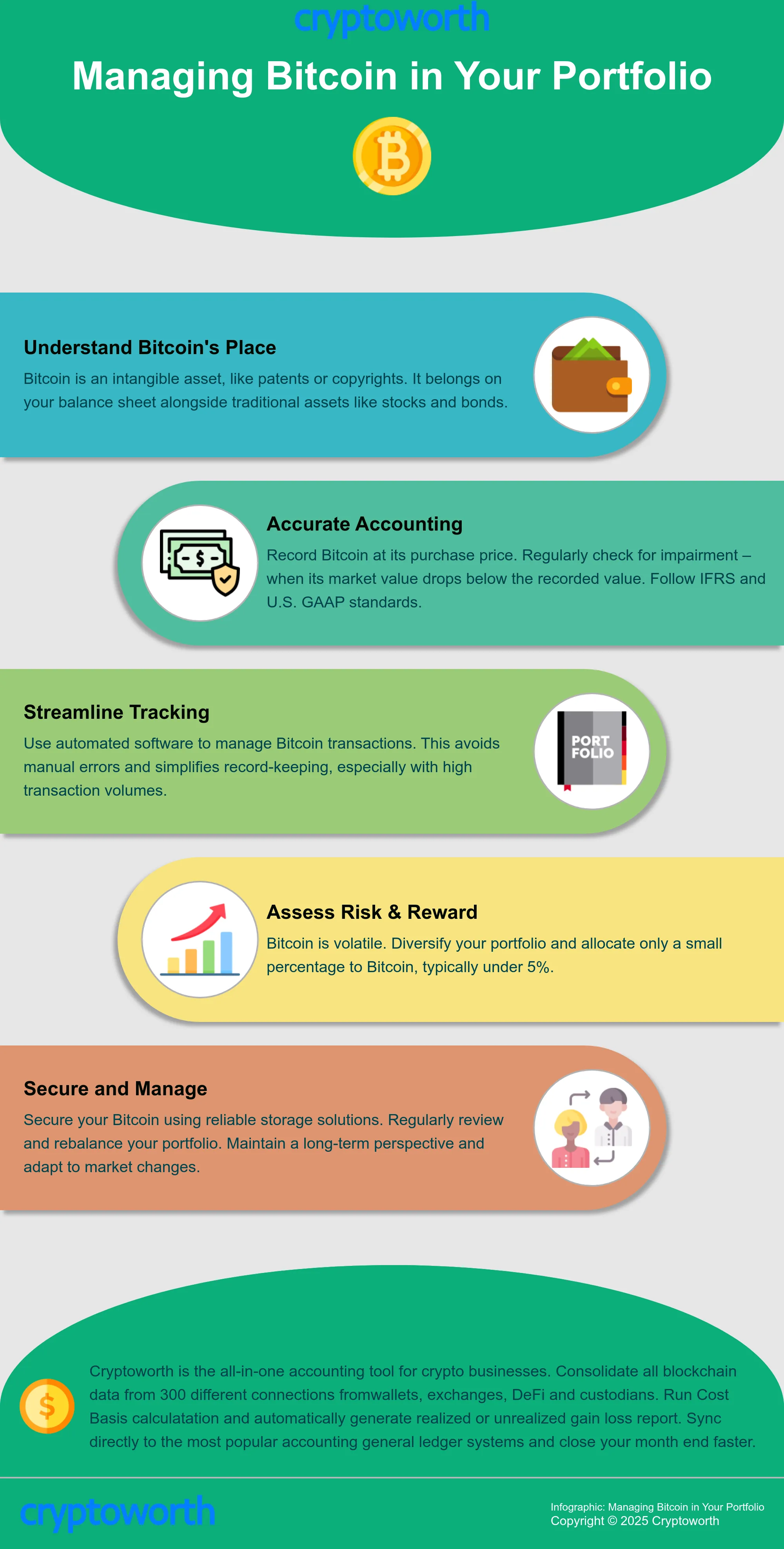
- Treat Bitcoin like other intangible assets: Record Bitcoin at its purchase price on your balance sheet. Adjust for any losses, following IFRS and U.S. GAAP standards.
- Track your Bitcoin transactions: Use automated software to simplify record-keeping and reduce errors, especially with high transaction volumes. This prepares you for audits and simplifies tax reporting.
- Manage your Bitcoin risk: Balance your portfolio with other assets to offset Bitcoin’s volatility. Secure your Bitcoin and stay informed about market changes to adapt your investment strategy.
What is a Bitcoin Portfolio Balance Sheet?
A Bitcoin portfolio balance sheet shows how you hold Bitcoin and other digital assets alongside traditional assets like stocks and bonds. It gives you a snapshot of your investments at a specific point in time. Think of it as a complete view of your financial health, investment-wise.
Definition
Bitcoin and other digital assets are intangible assets. This means they don’t have a physical form but still hold value. This categorization is important because it affects how Bitcoin is treated on your balance sheet under both IFRS and GAAP.
Why it Matters for Investors
Companies hold Bitcoin as a reserve asset, similar to cash or treasury bills. This strategy can help hedge against inflation and currency fluctuations. It also diversifies holdings and may increase market capitalization. Individual investors can also benefit from including Bitcoin on a balance sheet for a clearer picture of their net worth.
Key Elements and Accounting Standards
Bitcoin is now measured at fair market value under the new Financial Accounting Standards Board (FASB) guidelines, effective for fiscal years starting after December 15, 2024. Unlike the previous impairment model, fair value accounting ensures that Bitcoin’s value reflects its current market price, with changes in value recognized as gains or losses in net income. This updated approach eliminates the need to check for impairments and allows for a more accurate and transparent reflection of financial health.
Account for Bitcoin on Your Balance Sheet
Keeping accurate records of your Bitcoin holdings is essential for sound financial decisions. This section explains how to account for Bitcoin on your balance sheet, covering relevant accounting standards and practical tips.
IFRS and U.S. GAAP standards
Bitcoin and other cryptocurrencies are generally classified as intangible assets under both IFRS and GAAP. This means they’re treated similarly to patents or copyrights—they lack physical substance but hold future economic benefits. This classification affects how Bitcoin is valued and reported on your balance sheet. With the transition to fair value accounting in 2025, this classification now incorporates real-time valuation adjustments, aligning with modern financial reporting needs.
Value Bitcoin with Fair Market Value
Under the new fair value model, Bitcoin is recorded and adjusted based on its current market value during each reporting period. This approach provides a real-time snapshot of financial health by reflecting both unrealized gains and losses directly in financial statements. Unlike the prior impairment model, where losses were recognized but gains were only reported upon sale, fair value accounting eliminates these constraints, creating a more dynamic and accurate valuation method.
Common record-keeping challenges
Bitcoin’s unique characteristics still present record-keeping challenges despite the shift to fair value accounting. Its decentralized nature, high transaction volume, and use across multiple wallets and exchanges can make tracking and reconciling data complex. Manually entering transaction data increases the risk of errors and can be time-consuming. Additionally, complex cryptocurrency transactions, such as staking, cross-chain swaps, or wrapped tokens, require advanced accounting systems to ensure compliance with evolving standards. reconciling data is difficult. Manually entering transaction data from various wallets and exchanges is time-consuming and prone to errors. The changing regulatory landscape and complex transactions like staking or wrapped tokens add more complexity.
Automate transaction management
Automated crypto accounting software can simplify these processes. These tools automatically import and standardize transaction data from various sources and perform calculations according to relevant accounting standards. This reduces manual work, minimizes errors, and frees up your time. Automating transaction management helps ensure your Bitcoin records are accurate, complete, and audit-ready. By adopting automation, businesses can focus on strategic decision-making while staying compliant with updated reporting requirements.
Balancing Crypto Risks of Bitcoin
As you consider adding Bitcoin to your investment portfolio, it’s essential to understand both the potential upsides and the crypto risks. Like any investment, Bitcoin has characteristics that can influence your financial goals.
Potential rewards
Some companies treat Bitcoin as a reserve asset, much like cash or T-bills. They might do this to hedge against inflation, currency devaluation, or geopolitical risks. Bitcoin can also diversify holdings and potentially increase market cap.
Volatility and market dynamics
Bitcoin’s price can be volatile. This can impact the stock price of companies that hold it. Daily swings of 5% or more are common. Bitcoin saw losses of 64% in 2022 and 74% in 2018, according to CNBC. A 100% return is needed to recover from a 50% loss.
Regulatory and security factors
Digital assets like Bitcoin aren’t insured by the FDIC or protected by the SIPC. Fidelity outlines considerations for Bitcoin investments, including its volatile nature and unpredictable market movements. This lack of traditional safeguards requires careful bitcoin risk assessment.

Understanding SAB 122 and its Impact Under Trump’s SEC.
The recent issuance of Staff Accounting Bulletin (SAB) 122 marks a pivotal moment in the accounting landscape, It signals a…

SAB 121 Summary and Its Latest Developments
The SEC has just revoked the accounting bulletin SAB 121, lifting the constraints on financial institutions in the United States….
Diversification benefits
One way to manage Bitcoin’s volatility is through diversification. Allocate only a portion of your portfolio to Bitcoin. Spread your investments across different asset classes to reduce the impact of price swings. This approach can help balance potential gains with a measured approach to risk.
Determine Your Ideal Bitcoin Allocation
Deciding how much Bitcoin to hold depends on your risk tolerance and financial goals. It’s a personal decision, but some general guidelines can help.
Expert advice on Bitcoin percentage
Financial experts often recommend keeping Bitcoin investments relatively small—under 5% of your total portfolio. Some suggest an even more conservative approach, limiting it to 1% or 2%, or even avoiding it entirely. CNBC highlights this cautious stance among experts. This advice reflects the inherent volatility of Bitcoin.
Factors to consider
Bitcoin’s price can change dramatically and unpredictably. Fidelity points out this market volatility. This makes Bitcoin a higher-risk investment. Consider your comfort level with potential losses before investing. Your age, income, and existing investments all contribute to finding the right Bitcoin balance for you.
Balance Bitcoin with other assets
Think of your investment portfolio like a diversified meal. You wouldn’t want just one food group. The same idea applies to investments. Diversification is key. Markets.com emphasizes spreading your investments across different asset classes. This helps reduce your overall risk. If Bitcoin’s value drops, your other investments can help offset the impact.
Manage and balance crypto risk
Remember, Bitcoin isn’t like a traditional bank deposit. It’s not insured by the FDIC or SIPC. Fidelity’s insights on digital assets highlight this. There’s a chance you could lose some, or even all, of your Bitcoin investment. Start small and only invest what you can afford to lose. You can adjust your Bitcoin holdings over time as you gain experience and confidence.
Enhancing Accuracy in Multi-Entity Crypto Accounting
Managing a Bitcoin portfolio across multiple entities can be complex, requiring precise consolidation and reporting. Make sure to be updated on how multi-entity accounting software simplifies reconciliation and provides real-time financial insights.
Manage Your Bitcoin Investments Effectively
Successfully managing Bitcoin requires a blend of security, ongoing portfolio assessment, smart tools, and a long-term perspective. Let’s break down each element.
Secure your Bitcoin holdings
Bitcoin’s value fluctuates, so protecting your investment is key. Robust risk management strategies, like hedging or diversifying, are essential. Secure storage solutions, such as cold wallets, offer increased protection against potential threats.
Review and rebalance your portfolio
Consider keeping your Bitcoin holdings a small part of your overall investment portfolio. Some financial experts recommend a maximum of 5% allocation to Bitcoin, with some even suggesting 1–2%. Regularly review and adjust your portfolio to maintain your target asset allocation. This helps manage risk effectively.
Use automated tools
Automated tools can simplify many aspects of Bitcoin management, like crypto accounting software. They handle large-scale standardizations, reducing manual work and the chance of errors. This efficiency is especially helpful given the typically high volume of Bitcoin transactions.
Cryptoworth’s platform offers a robust solution tailored to these challenges. With features such as automated data imports from wallets, exchanges, and blockchains, Cryptoworth streamlines the entire process—from transaction classification to fair value calculations. The platform ensures compliance with the latest accounting standards while minimizing errors and saving valuable time. Additionally, Cryptoworth’s tools help finance teams generate audit-ready reports, enabling businesses to meet reporting deadlines with confidence. By adopting Cryptoworth’s solution, organizations can focus on strategic financial decisions, leaving the complexities of manual data management behind.
Maintain a long-term view and adapt to market changes
A long-term investment strategy of four years or more can help you weather market fluctuations. Stay informed about market trends and regulations so you can adapt your strategy when needed. Flexibility is important in the ever-changing crypto market.
Related Articles
- How to Report all your Bitcoin Wallet trades to close month-end?
- Get Bitcoin Wallet financial data for accounting and tax
- A Quick Approach to Cryptocurrency Accounting
- Bitcoin 2024: Corporate Adoption of Bitcoin as a Treasury Reserve
- Find the Cryptocurrency Market Value: An Accountant’s Guide
- Crypto Treasury Management: A Quick Guide
- New Insights on Multi-Entity Complexities for Family Office Clients
Frequently Asked Questions
How does Bitcoin’s classification as an intangible asset affect its accounting treatment?
Classifying Bitcoin as an intangible asset under IFRS and U.S. GAAP historically meant treating it similarly to other non-physical assets with future economic benefits, like patents or copyrights. Previously, this classification impacted how Bitcoin was initially recorded (at historical cost) and how changes in its value were handled, particularly impairment losses. However, with the transition to fair value accounting in 2025, Bitcoin is now adjusted to reflect its current market price, creating a more dynamic and transparent valuation process.
Why was impairment such a critical concept for Bitcoin on a balance sheet?
Under the old impairment model, Bitcoin’s value fluctuations required frequent assessments. Impairment occurred when the market value fell below the recorded value on the balance sheet, leading to recognized losses. These losses were critical for accurate financial reporting but were irreversible, even if Bitcoin’s price later rebounded. The introduction of fair value accounting eliminates the reliance on impairment testing by reflecting both gains and losses in real time, addressing the limitations of the earlier approach.
What’s the biggest challenge in keeping accurate Bitcoin records, and how can I overcome it?
The decentralized nature and high transaction volume of Bitcoin make manual tracking complex and error-prone. Automated crypto accounting software helps by directly importing transaction data, standardizing it, and performing calculations according to accounting standards, saving you time and reducing errors.
If a company holds Bitcoin, how does its volatility affect the company’s stock price?
Bitcoin’s price swings can directly impact a company’s stock price if they hold a substantial amount. This volatility is a key factor to consider when evaluating companies with Bitcoin on their balance sheets. Diversification within the company’s holdings can help mitigate this risk.
How much Bitcoin should I hold in my investment portfolio, and what factors should I consider?
Financial experts generally advise keeping Bitcoin holdings relatively small, often under 5% of your total portfolio, due to its volatility. Your risk tolerance, financial goals, age, and existing investments should all inform your decision. Diversifying your holdings across different asset classes is a good strategy to manage risk.
How to Do Bitcoin Accounting on Your Balance Sheet?
Treat Bitcoin like other intangible assets: Record Bitcoin at its purchase price on your balance sheet. Track your Bitcoin transactions: Use automated crypto accounting software to simplify record-keeping and reduce errors, especially with high transaction volumes. This prepares you for audits and simplifies tax reporting. Balance your portfolio with other assets to offset Bitcoin’s volatility. Secure your Bitcoin

Leave a Comment