

Staking Rewards Accounting: A Comprehensive Practical Guide

Staking your crypto assets can be a rewarding experience, both financially and in terms of contributing to the blockchain ecosystem. However, the world of staking rewards accounting can quickly become a tangled web of calculations, classifications, and compliance requirements.
Don’t let the complexities of staking rewards accounting overshadow your success. This guide provides a clear roadmap to managing your staking rewards, from understanding the basics of staking mechanisms to mastering advanced reporting techniques. We’ll explore the challenges, best practices, and tools that will empower you to take control of your staking rewards and maximize their value.
Simplify staking rewards tracking with crypto accounting software designed for staking income recognition and tax compliance. A digital asset reporting platform for automating staking reward calculations and reconciling on chain earnings helps you stay accurate, compliant, and in control of your blockchain-based income.
Table of Contents
- Key Takeaways
- What Are Staking Rewards?
- Staking Rewards Accounting: IFRS vs. GAAP
- Tax Implications of Staking Rewards
- Best Practices for Tracking and Reporting Staking Rewards
- Challenges in Staking Rewards Accounting
- Reporting Staking Rewards in Financial Statements
- Staking Rewards and Cash Flow Management
- Audit Considerations for Staking Rewards
- Streamlining Staking Rewards Accounting with Automation
- Related Articles
- Frequently Asked Questions
Key Takeaways
- Accurate accounting for staking rewards keeps you compliant and financially sound: Understand the rules under IFRS or GAAP. Detailed records are key, and specialized software can help manage the complexity of staking.
- Automated tools simplify staking reward management: Save time and reduce errors by automating data collection and reporting. Choose a solution that supports multiple blockchains, offers real-time monitoring, and connects with your accounting software.
- Talk to your accountant about your staking activities: Clear records, verifiable transactions, and open communication make audits smoother. Explain your staking strategy, accounting methods, and tracking tools.
What Are Staking Rewards?
Staking is like earning interest on your crypto. You lock up your cryptocurrency to support the blockchain network’s operations and security. Think of it as contributing to the network’s stability and earning rewards in return. Those rewards are called staking rewards. They’re typically paid in the same cryptocurrency you stake, but this can vary.
How Staking Generates Rewards
ETH Staking rewards, or any native token stake, come from a process called validating. Validators propose and validate new blocks of transactions added to the blockchain. These validators are key to securing the network. They’re chosen based on how many tokens they’ve staked—more tokens mean a higher chance of validating. Staking rewards encourages people to contribute to the network’s security and efficiency.
If a validator works solo, their rewards are often treated as “other income.” If they’re part of a larger staking pool, their work might be seen as a service. The rewards could then be considered revenue. Staking rewards are usually paid in the same cryptocurrency, not cash. Under IFRS 15, these rewards are valued at their fair market value when the staking agreement begins.
Types of Staking Mechanisms
There are two main types of stakers:
- Validators: Actively verify transactions and add new blocks to the blockchain
- Delegators: They lend their crypto to validators to boost the validator’s stake and chances of being chosen for validation.
Both earn rewards, but the distribution and accounting can be different. If the validator does the main work, the delegator’s rewards are generally considered revenue.
Staking Rewards Accounting: IFRS vs. GAAP
Staking rewards, generated from participating in proof-of-stake blockchain networks, present unique accounting challenges. Let’s break down how these rewards are treated under both International Financial Reporting Standards (IFRS) and Generally Accepted Accounting Principles (GAAP).
IFRS Treatment
Under IFRS 15, Revenue from Contracts with Customers, accounting for staking rewards requires careful analysis. This standard emphasizes evaluating the specific contract terms, the cryptocurrency’s nature, and the blockchain protocol. Staking rewards are often paid in the cryptocurrency itself. These rewards should be valued at their fair market value when the staking agreement begins. This valuation can be tricky due to cryptocurrency price volatility.
GAAP Treatment
GAAP’s guidance on staking rewards is less defined than IFRS. The accounting treatment differs between validators (those verifying transactions) and delegators (those lending their crypto). This distinction affects how staking rewards are recognized. GAAP offers some direction on accounting for validator transaction fees and staking rewards. However, the lack of clear standards for crypto assets adds complexity. Accountants must consider the specific facts and circumstances of each staking arrangement. KPMG’s insights offer further information on this evolving area.
Key Differences and Similarities
Both IFRS and GAAP lack universally accepted standards specifically for crypto staking. This presents challenges for businesses. Both frameworks emphasize understanding the specifics of the staking arrangement. Whether someone acts as a validator or a delegator significantly impacts how staking rewards are accounted for under both IFRS and GAAP. This highlights the need for a tailored approach. As Chetan Hans, partner at Grant Thorton Singapore, notes in his analysis, the landscape is complex and requires careful consideration.

Web3 Accounting from IFRS Standpoint

The International Financial Reporting Standards (IFRS) have provided some foundational guidelines for digital assets, but the field remains complex and…
Tax Implications of Staking Rewards
Taxes and staking rewards aren’t the most exciting topics, but understanding how they work together is essential. Let’s break down the tax implications so you can stay compliant and avoid surprises.
When Staking Rewards Become Taxable
Staking rewards are generally taxable income when you gain control over them. This is true even if your rewards are locked up for a set time. You’re taxed when you can access them, not just when you sell. This “dominion and control” principle means the IRS considers the rewards as income the moment they are available to you, regardless of whether you withdraw them immediately. For more information, Gordon Law Group offers a helpful resource on crypto staking taxes.
Reporting Staking Rewards on Tax Returns
How do you report these rewards? Report staking rewards as income based on their fair market value when you gain access. When you sell those staked assets, you’ll pay capital gains taxes on any profit. This isn’t double taxation. You’re taxed on the initial reward as income and then on the profit from the sale. We’ve covered this points in a conversation with Jozef Vogel and Jason Schwartz about Liquid Staking Tax Considerations.
Common Staking Tax Misconceptions
One misconception is that you only owe taxes when you sell your staking rewards. This isn’t true. The IRS views staking rewards as income upon receipt, regardless of where the coins are—your wallet or a third-party platform—as long as you can withdraw them. Another misconception is around the act of staking itself. Actions like starting to stake, withdrawing your stake, or selling rewards can also have tax implications, particularly concerning the ownership of your cryptocurrency during the staking period. Understanding these details helps you accurately report your staking activity and stay compliant.
Best Practices for Tracking and Reporting Staking Rewards
Accurate staking rewards tracking is crucial for informed financial decisions and tax compliance. Let’s look at some best practices to simplify this process.
Record-Keeping Strategies
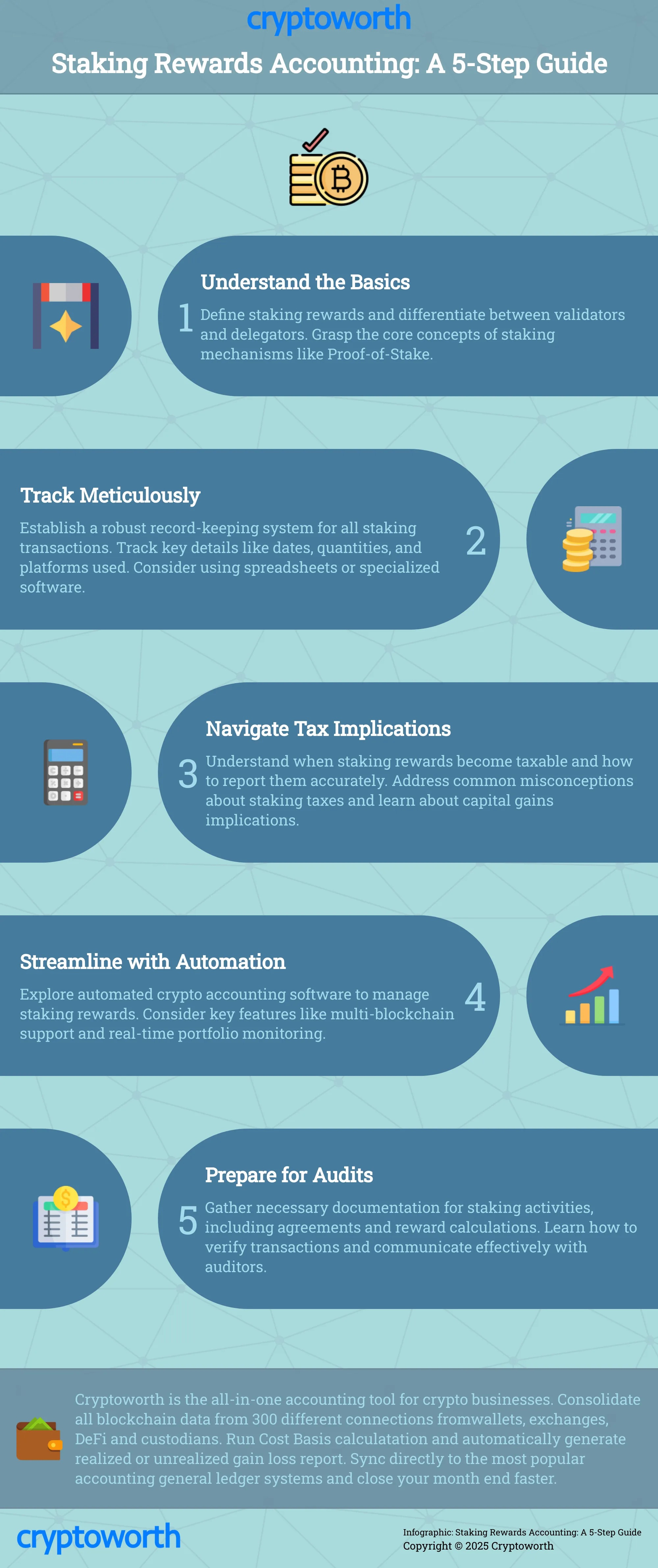
Maintaining detailed records of your staking activities is the foundation of accurate reporting. Think of it like a meticulous log of your investments. Track the date and time of each transaction, the specific cryptocurrency staked, the quantity, the staking platform used, and the rewards earned. This comprehensive approach simplifies tax reporting and helps you understand your staking performance. A well-organized spreadsheet or specialized crypto accounting software can be invaluable for managing this data.
Using Specialized Software
As your staking activities grow, manual tracking can become time-consuming and error-prone. Consider using specialized crypto accounting software like Cryptoworth. These tools automate collecting, classifying, and reconciling your staking data, freeing up your time. Features like automated transaction imports, cost-basis calculations, and support for various staking mechanisms streamline your workflow. This reduces errors and ensures your financial records are accurate and up-to-date. Plus, many platforms offer integrations with popular accounting systems, further simplifying your month-end close.
Integrating with Existing Accounting Systems
For seamless financial management, integrate your staking reward data with your existing accounting systems. Platforms like Cryptoworth offer integrations with solutions like QuickBooks, Xero, and NetSuite. This eliminates manual data entry, reducing errors and saving you time. It also provides a centralized view of your financial data, making it easier to generate reports, analyze performance, and make informed business decisions. This streamlined approach ensures your staking rewards are accurately reflected in your overall financial picture and simplifies the audit process, providing readily accessible and verifiable records.
Challenges in Staking Rewards Accounting
Staking rewards can be a great way to earn passive income with your crypto. But, like any financial activity, staking has unique accounting challenges. Let’s break them down.
Valuation Fluctuations
Staking rewards are typically paid out in the same cryptocurrency you stake. This means the value of your rewards fluctuates with the market. Under IFRS 15, rewards are valued at their fair market value when the staking agreement begins. Changes in value after this point are treated separately. You need a system to track these fluctuations for accurate records.
Network-Specific Considerations
Each blockchain network has its own rules for staking. These differences affect how you account for staking rewards. For example, the way a validator operates versus a delegator impacts the accounting treatment. Understanding these nuances is key. Start by learning about common staking mechanisms.
Regulatory Compliance
Staying compliant with tax regulations and accounting standards adds complexity. Classifying and reporting these rewards can be tricky. Treatment under IFRS 15 and other income categories depends on your business model and contracts. Consult a crypto accounting expert for guidance. The rules are intricate and vary depending on your specific situation.
Reporting Staking Rewards in Financial Statements
Properly reporting staking rewards is essential for clear financial statements. Let’s break down how these rewards affect different parts of your financials.
Income Statement Considerations
Staking rewards can show up on your income statement in a few ways. It depends on whether your business acts as a validator or a delegator. Validators actively participate in network consensus. They earn both transaction fees and staking rewards. These earnings might be classified as “other income” or revenue. This depends on your core business operations. For example, if validating is a primary business activity, the rewards likely count as revenue. If you’re part of a validator pool, this adds another layer of complexity. You’ll need to carefully assess the service you provide within the pool. This will help determine the appropriate revenue recognition method.
Balance Sheet Impact
Staking rewards also influences your balance sheet. The main question is whether staked crypto assets themselves stay on your balance sheet. If you’re an independent validator, the rewards you earn are usually treated as “other income.” They don’t directly impact the staked assets. However, if you participate in a staking pool, the accounting treatment might differ. The classification and reporting of these assets can significantly affect your company’s overall financial position. So, accuracy is key.
Disclosure Requirements
Transparency is paramount when reporting staking rewards. Regardless of your specific staking activities, you must disclose key information in your financial statements. This includes the nature of your staking activities. It also includes the accounting policies you’ve chosen. And, it includes how these choices impact your overall financial picture. This ensures compliance with IFRS requirements. It also builds trust with stakeholders. Clear disclosures help investors and auditors understand your approach to staking. They’ll also understand its financial effects.
Staking Rewards and Cash Flow Management
Staking rewards can significantly impact your cash flow. Smart management of these rewards requires a clear understanding of liquidity, reinvestment strategies, and risk mitigation. Let’s break down each component.
Liquidity Considerations
Staking often involves locking up your crypto assets for a specific period. This can impact your ability to quickly access funds when needed. A solid grasp of your staking schedule and potential lock-up periods is essential for maintaining healthy liquidity. Services like Cryptoworth, crypto accounting software, can simplify staking rewards accounting, making revenue recognition more seamless and predictable. This clarity is helpful for investors who need to understand their liquid position. Tools like those offered by Ledger Leap can further enhance investor access and provide more efficient fund management.
Reinvestment Strategies
Staking rewards offer an opportunity to compound your returns through reinvestment. Automating this process can save you time and optimize your earnings. Platforms like Streamflow allow you to automatically deposit staking yields directly into your wallet, eliminating manual transactions. This streamlined approach simplifies reward management. Real-time portfolio monitoring can further enhance your reinvestment strategies by providing up-to-date information on your staking performance. This allows you to make informed decisions about reinvesting your rewards.
Risk Management
While staking can generate attractive rewards, it’s not without risks. Market volatility, slashing penalties, and smart contract vulnerabilities are all factors to consider. Mitigating these risks requires a proactive approach. Using a secure and scalable infrastructure for staking, such as the one provided by Galaxy, can help manage validator operations and minimize potential downtime. Automating key processes, as highlighted in our previous articles, can further reduce risk by minimizing human error and ensuring consistent best practices. A well-defined risk management strategy is essential for long-term success in staking.
Audit Considerations for Staking Rewards
Staking rewards, while potentially lucrative, introduces complexities to the audit process. Clear documentation, verifiable transactions, and proactive communication with your auditors are essential for a smooth audit.
Documentation Requirements
Auditors will want to see comprehensive records of your staking activities. This includes the terms of your staking agreements, the dates and amounts of rewards earned, and how you calculated the value of those rewards. Think of it like meticulously documenting your baking process—ingredients, measurements, oven temperature, baking time—so anyone can replicate your cake. Similarly, detailed staking records allow auditors to trace your steps and verify the accuracy of your financial reporting. This documentation helps demonstrate compliance with relevant accounting standards and tax regulations. At Cryptoworth, we offer automated staking accounting and bookkeeping, which can simplify this documentation process.
Verifying Staking Transactions
Beyond documentation, auditors need to verify the actual staking transactions on the blockchain. This involves confirming the movement of assets into and out of staking pools, as well as the receipt of staking rewards. Tools that provide real-time portfolio monitoring, like those offered by Ledger Leap, can be invaluable for this purpose. These tools offer transparency and allow auditors to independently verify the information you provide, ensuring the integrity of your staking data and building trust with your auditors.
Addressing Auditor Concerns
Proactive communication with your auditors is key to addressing any concerns they may have. Explain your staking strategy, your accounting methods, and the tools you use to track and report staking rewards. This open communication can prevent misunderstandings and streamline the audit process. By anticipating potential questions and providing clear explanations, you can build confidence in your staking operations. Services that can offer validator management and staking position monitoring, which can further enhance transparency and address auditor concerns. A well-informed auditor is a happy auditor.
Streamlining Staking Rewards Accounting with Automation
As the crypto world expands, managing staking rewards gets more complex. Manually tracking these rewards can be time-consuming and prone to errors. Automating this process frees up your time and resources, so you can focus on other parts of your business.
Benefits of Automated Solutions
Automated solutions offer several key advantages. They streamline recording and classifying rewards, reducing manual errors and improving accuracy in financial reporting. Automation saves you time, especially if your business has many transactions. This lets your accounting team focus on higher-value work like financial analysis and planning. Automated systems can often integrate directly with your current accounting software, like QuickBooks, creating a single financial view and simplifying reporting. Automated software emphasizes how automation empowers your team and reduces manual tasks.
Key Features to Look For
When choosing an automated solution, consider the key features described in our article “8 Most Important Features in Cryptocurrency Accounting Solutions“. Look for a platform supporting various staking mechanisms and integrating with multiple blockchains. Real-time portfolio monitoring and automated reward allocation are essential for current financial data. Detailed reporting for accounting and tax purposes is also important. Ensure the platform complies with accounting standards like IFRS and US GAAP, and its up to date with regulatory publications like 1099da and Revenue Procedure 2024-28, if you’re at an US-based company.
Implementation Strategies
Implementing an automated system can be simple with the right approach. First, define your needs and goals. This helps you choose the best software. Next, ensure the platform integrates with your existing systems. This might involve migrating data or using API connections. Testing and training are vital for a smooth transition. Working with staking providers that offers support during implementation can help you get started quickly and efficiently. A well-implemented system significantly improves the accuracy and efficiency of your staking rewards accounting.
Related Articles
- Accounting for Staking Rewards: A Quick Dive Under IFRS
- Two Proven Ways for Treating Staking Income In Accounting
- Staking Crypto Accounting Solution – Cryptoworth
- How to Report all your Stake Tax trades to close month-end?
- WEBINAR: Liquid Staking for Accurate DeFi Accounting
Frequently Asked Questions
Staking rewards are generally taxable when you gain control over them, even if they’re locked up for a period. They’re taxed based on their fair market value at the time you can access them. When you eventually sell, you’ll pay capital gains tax on any profit. This isn’t double taxation; it’s taxing the initial reward as income and then the profit from the sale.
Validators actively participate in securing the blockchain by proposing and verifying transactions. Delegators contribute their crypto to validators to increase their chances of being chosen for validation. Both earn rewards, but validators typically earn more due to their active role. The accounting treatment for rewards can also differ between the two.
Accurate tracking is essential for both financial reporting and tax compliance. It helps you understand your staking performance, calculate your tax liability, and ensure your financial statements are accurate. Detailed records also simplify the audit process.
Specialized crypto accounting software can automate much of the process, saving you time and reducing errors. Look for software that integrates with your existing accounting systems and supports various staking mechanisms. Maintaining organized records of transaction details, including dates, quantities, and platforms used, is also helpful.
The fluctuating value of cryptocurrency, network-specific rules, and evolving regulatory compliance requirements all contribute to the complexity of staking rewards accounting. Staying updated on these factors and seeking professional guidance can help you address these challenges effectively.
Leave a Comment