
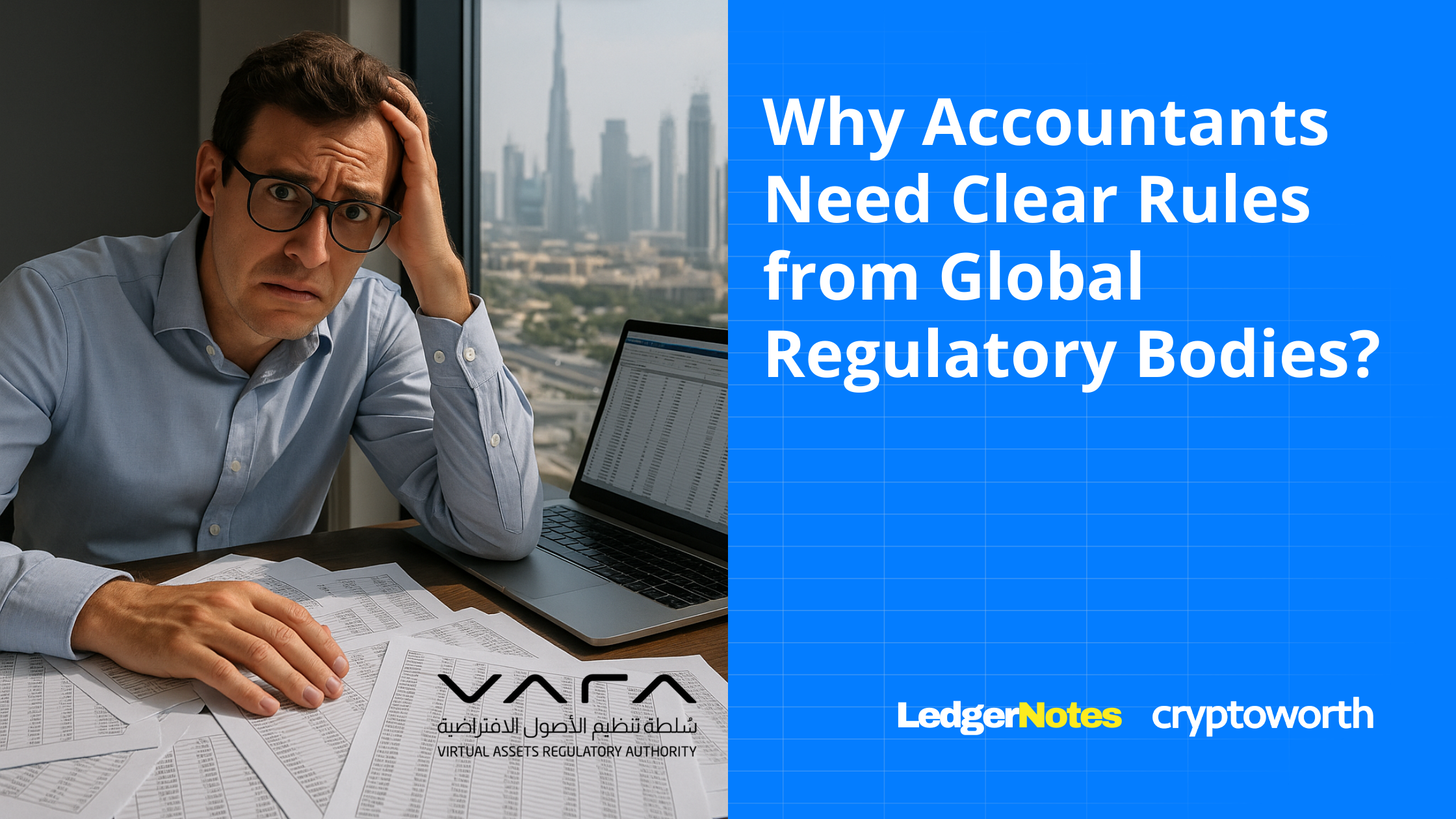

Accounting teams working with digital assets face a unique problem. Fragmented regulations and inconsistent data standards turn even routine reporting into a complex, manual process. In this article, we look at why clear, global rules matter so much for accountants and how industry leaders are working to standardize digital asset reporting.
This article is part two of a two-part series on digital asset regulation from Paris Blockchain Week. In part one, we explored how Matthew White and VARA are setting a new standard for regulation. Here, we turn to why these changes matter for accountants and finance teams, and how technology helps bridge the gap. If you missed the regulatory deep dive, see the link at the end of this article.
For more takeaways and session summaries from Paris Blockchain Week, visit the full LedgerNotes PBW recap page.
Regulatory Fragmentation Threatens Crypto Accounting
Accounting teams working with digital assets face more than just technical hurdles. Regulatory fragmentation and inconsistent data standards across jurisdictions make even routine reporting complicated and risky. Without unified rules and standards, accountants must manage and resolve a maze of requirements, turning basic financial reporting into a manual, error-prone process.
Why Accountants and Finance Teams Should Care
Standard Clarity in Digital Asset Reporting
For accountants and finance team leaders, consistent standards are essential. Matthew White’s approach at VARA is to build this clarity through a flexible, activity-based framework. VARA doesn’t create a new rule for every product. Instead, it sets broad principles for how digital asset activities should be conducted. This keeps expectations consistent even as the industry changes.
Here’s a brief, accurate summary of how White’s leadership of VARA are approaching clarity:
- Principles-Based and Activity-Based Framework:
Instead of writing a long list of rules for every new product, VARA defines broad principles tied to activities, not products or technologies. This allows for consistency even as new business models emerge. - Continuous Engagement with Industry:
VARA spends significant time meeting with crypto businesses to understand real-world challenges. They then adjust rules and guidance based on these ongoing conversations. - Transparency in Rule-Making:
VARA’s regulatory documents are public, easy to find, and updated as needed. They prioritize open communication about what is expected from businesses. - Agility and Adaptation:
Rather than waiting to react to crises, VARA proactively monitors trends and adapts its framework. The aim is to stay relevant as the market evolves.
Matthew White and his team regularly meet with industry participants to refine their rules in real time. Their guidance is published openly and updated to address market feedback. This open, adaptive approach helps businesses and accountants know exactly where they stand, wherever they operate.
Industry groups like those behind SoDA and the Global Blockchain Association’s accounting committee are also pushing for this kind of harmonization. With clearer global standards, accountants can spend less time decoding regulations and more time focusing on accurate, efficient digital asset reporting.
The Accountant’s Pain Points
For digital asset accountants, regulatory fragmentation is more than just policy talk. It means manual work, duplicated processes, and a higher risk of errors in every financial statement. When stablecoin and tokenization rules differ from country to country, teams must map each transaction to local requirements, often rewriting reports for every jurisdiction. This creates a drain on resources and makes it harder to ensure accuracy.
The need for international convergence is real. Without global alignment, accountants will keep facing time-consuming reconciliations and compliance checks. VARA’s push for collaboration is about reducing this burden. By setting clear, harmonized standards, regulators can make life easier for accountants and controllers in the digital asset space. And open the door to smoother cross-border business.
The Importance of Standardized, Transparent Data
Accountants need more than just clear rules. They need standardized, usable data they can trust. John O’Connell, in the LedgerNotes recap, stressed that real progress depends on financial professionals and technology leaders speaking the same language. The specific regulator matters less than having consistent data formats and classifications across borders. Without that, confusion and extra manual work persist.
Industry groups are working to solve this. The Statement of Digital Assets (SoDA) and the accounting committee of the Global Blockchain Association are both leading efforts to create industry-driven solutions. Their work on harmonized taxonomies and transparent reporting helps reduce friction for everyone working with digital assets.
This is exactly where accounting software like Cryptoworth comes in. Cryptoworth is designed to bring all blockchain and exchange data into a single, reliable format for accountants and finance teams. By aligning with industry standards and offering automated reporting, tools like Cryptoworth make it possible to turn complex transaction data into accurate, compliant financial records, no matter where a transaction starts or finishes.
LedgerNotes Recap
Want to stay ahead on digital asset regulation and accounting trends?
Subscribe to LedgerNotes for expert recaps and practical insights from the world’s top crypto conferences.
Read more about other sessions from Paris Blockchain Week in our in-depth event summary.
Sign up to get notified about upcoming coverage of Token2049, Consensus, Bitcoin 2025, and other major industry events.
LedgerNotes delivers the highlights, the context, and the practical takeaways that finance professionals need.
Continue Reading:
Interested in the regulatory playbook behind these accounting changes?
Read part one of this series: “VARA’s Playbook for Digital Asset Regulation: Paris Blockchain Week Spotlight” to understand the philosophy and structure guiding global digital asset regulation.

Leave a Comment