


If your company owns a subsidiary or operates as one, its accounting processes differ significantly from traditional single-entity accounting. Recording the journal entry for investment in a subsidiary is crucial, as shared expenses, revenues, and other overlapping financial line items can distort actual totals, potentially leading to compliance risks or legal complications.
Moreover, there is no universal accounting method that applies to all subsidiaries. Different circumstances require different approaches when determining the correct investment in subsidiary accounting entry. In this guide, we will delve into various subsidiary accounting methods, explain when to use them, and explore how to record an accurate investment in subsidiary journal entry while establishing an efficient, largely automated accounting process.
Streamline complex multi-entity workflows with crypto accounting software that supports investment in subsidiary journal entries and consolidated reporting. A digital asset subledger platform built for multi-entity crypto accounting and reconciliation helps you reduce errors, maintain compliance, and simplify intercompany tracking across your entire organization.
What is a Subsidiary?
A subsidiary is a company owned or controlled by another company, known as the parent company. This relationship often arises through significant shareholding, granting the parent company control over the subsidiary’s operations and financial decisions. The subsidiary typically operates as an independent entity, but the parent company holds the ultimate authority over major decisions, ensuring alignment with overarching corporate objectives.
Subsidiaries are created for various strategic reasons, such as entering new markets, reducing risks, or diversifying operations. They can take different forms, including wholly-owned subsidiaries where the parent owns 100% of the shares or partially-owned subsidiaries with minority shareholders.
- subsidiaries that are wholly owned by the parent company, where 100% of the shares are held,
- subsidiaries that are partially owned, with the parent holding a majority but not full ownership.
Understanding these distinctions is vital for accurate accounting and regulatory compliance.
Subsidiaries also enable parent companies to legally isolate liabilities or focus on specialized business activities. This structure is particularly advantageous in industries with complex regulatory environments or volatile market conditions. Additionally, subsidiaries often serve as a testing ground for innovative products and services, providing flexibility without risking the parent company’s core operations.
Methods of Accounting for Subsidiaries
Accurately accounting for a subsidiary requires selecting an appropriate method. Depending on the parent company’s level of control and influence, the most common methods are consolidation and equity.
Choosing the right method ensures that financial reporting reflects the true relationship between the parent and subsidiary.
Other factors, such as local regulations, the subsidiary’s financial health, and operational independence, may also influence the accounting approach. For instance, some jurisdictions may require specific disclosures or accounting treatments for partially owned subsidiaries, further complicating the process.
Explanation of the Consolidation Accounting Method
The consolidation method is applied when the parent company exercises control over the subsidiary, typically through ownership of more than 50% of its voting shares. This approach combines the financial statements of the parent and subsidiary into a single consolidated financial statement. Consolidation ensures that the financial performance of the entire corporate structure is accurately represented.
Consolidation involves eliminating intercompany transactions, such as loans, revenues, or expenses between the parent and subsidiary. This step is critical to prevent inflation of financial results. Additionally, adjustments are often made to align accounting policies across entities, ensuring consistency in reporting.
The consolidation method also requires the parent company to disclose details about non-controlling interests (minority shareholders), providing transparency in how profits and losses are allocated. Such disclosures are vital for investors and regulatory bodies to understand the financial health of the group as a whole.
Examples Demonstrating the Consolidation Method
Manual Consolidation Accounting Example
Using the manual approach, the parent company aggregates the subsidiary’s financial data, eliminating intercompany transactions and balances to avoid double counting. For example, if the parent company sells goods to its subsidiary, the revenue recognized by the parent and the expense recorded by the subsidiary must be removed in the consolidated financial statements. This process can be labor-intensive and prone to errors without proper checks.

Manual consolidation is often used by smaller organizations or those with limited financial software capabilities. However, the complexity increases as the number of subsidiaries grows, making automation a necessity for scalability.
Automated Consolidation Accounting Example
Modern accounting software can automate the consolidation process, streamlining the integration of financial statements and ensuring compliance with relevant standards. Automated tools can detect and eliminate intercompany transactions, saving significant time and reducing the risk of inaccuracies. Cryptoworth, for example, offers features that simplify consolidation, making it an ideal solution for businesses managing multiple subsidiaries.
Automation also enables real-time financial reporting, a significant advantage for organizations operating in fast-paced industries. By providing instant access to consolidated data, decision-makers can respond quickly to market changes or internal challenges.
What You Need to Know About the Equity Method
The equity method is used when the parent company has significant influence but not full control over the subsidiary, often defined as owning 20% to 50% of the voting shares. Under this method, the parent recognizes its share of the subsidiary’s profits or losses in its financial statements. This approach provides a more realistic representation of the parent’s financial position and performance.
The equity method also requires periodic adjustments to reflect changes in the subsidiary’s equity. For instance, dividends received from the subsidiary reduce the parent’s investment account, ensuring that the parent’s financial statements accurately represent the economic relationship.
The equity method is particularly useful for joint ventures or strategic partnerships where the parent company participates in significant decision-making processes without exerting full control. This method allows for more accurate financial reporting while respecting the operational independence of the subsidiary.
Equity Method Accounting Explained
For example, if a parent company owns 25% of a subsidiary and the subsidiary reports a $100,000 profit, the parent records $25,000 as income in its financial statements. Similarly, if the subsidiary incurs a loss, the parent recognizes its proportionate share, reducing the reported investment value.
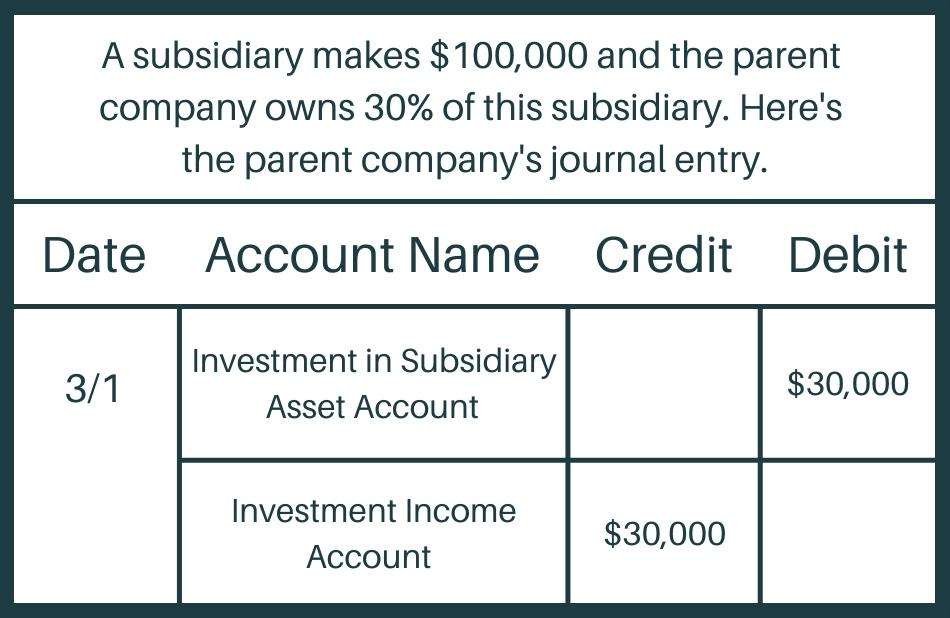
Another scenario involves revaluation of the subsidiary’s assets, such as property or equipment. Any increase or decrease in value would impact the parent’s reported investment, highlighting the interconnected nature of their financial performance.

Key Questions Answered
How do you account for investment in a subsidiary?
To account for an investment in a subsidiary, determine the level of control or influence to choose the appropriate method, such as consolidation or equity. Record the initial investment at fair value and subsequently adjust for share of profits, losses, or other changes, depending on the method applied. Proper documentation and regular reviews are essential to ensure accurate reporting and compliance.
What is the journal entry for an investment?
The journal entry for an investment in a subsidiary typically includes debiting the investment account and crediting cash or another asset used for the purchase. For example:
Debit: Investment in Subsidiary  $1,000,000
Credit: Cash                     $1,000,000
Over time, adjustments may be necessary to reflect dividends, impairment, or changes in the subsidiary’s value.
How do I report an investment in a subsidiary?
Report an investment in a subsidiary based on the chosen accounting method. For consolidation, the subsidiary’s financials are merged into the parent’s. For the equity method, show the investment as a non-current asset with periodic adjustments for the parent’s share of the subsidiary’s profits or losses. Clear and transparent reporting builds investor confidence and ensures compliance with regulatory standards.
Is investment in a subsidiary a debit or credit?
Investment in a subsidiary is recorded as a debit to the investment account because it represents an asset acquisition. The corresponding credit typically reflects the source of funds used for the investment, such as cash or liabilities. Understanding these entries is fundamental to maintaining accurate financial records.
Selecting the Best Software for Subsidiary Accounting
Advanced accounting software simplifies subsidiary accounting processes, offering features such as automated consolidation, equity method calculations, and compliance monitoring. Cryptoworth is an excellent choice for businesses seeking efficient and reliable subsidiary accounting solutions.
Cryptoworth is the best option for businesses of all sizes. It simplifies complex accounting with features like automated transaction importing, cost-basis calculations, and support for multiple accounting methods. This automation frees up your team to focus on more strategic tasks. Learn more about how Cryptoworth helps accountants close month-end faster.
Choosing the right software not only improves accuracy but also enhances scalability. As businesses grow and acquire more subsidiaries, tools like Cryptoworth ensure seamless integration, making subsidiary management efficient and stress-free.
Effective use of such software can also reduce audit risks by maintaining detailed records and ensuring compliance with local and international accounting standards. Investing in technology is a forward-thinking approach that equips businesses to handle the complexities of modern subsidiary accounting with ease.


Leave a Comment